I am excited to announce a new edition of Driver’s License Revocations, Restorations, and Limited Driving Privileges in North Carolina. First published in 2024 by my colleague Shea Denning, this publication covers every driver’s license revocation, conditional restoration, and limited driving privilege available to drivers in North Carolina. Due to statutory changes that took effect December 1, 2025, we’ve put together this 2025 edition, now available here. Read on for more about the book and the updates.
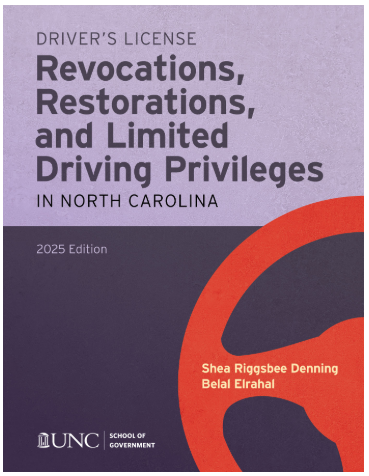
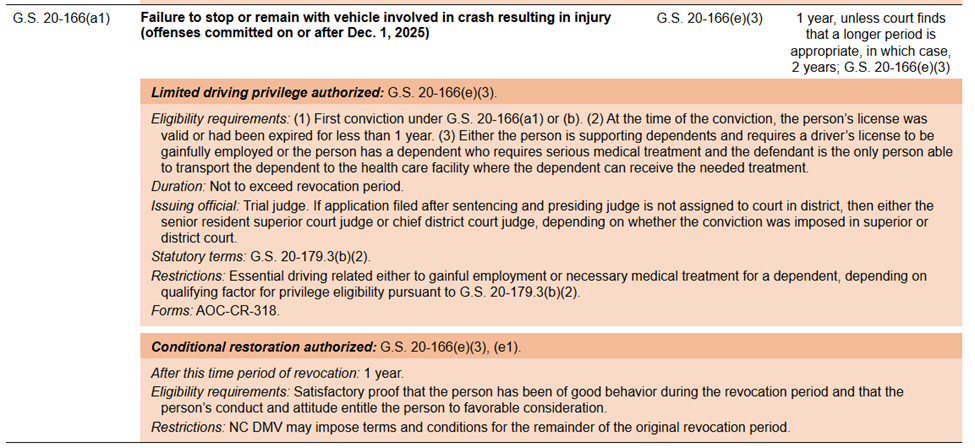
The book. For every license revocation a driver may be subject to, the book provides the conviction statute, offense description/triggering event, revocation statute, and length of revocation. If a conditional restoration is permitted, it is included beneath each revocation, and includes the authorizing statute, how long the person must remain revoked, eligibility requirements, and restrictions on the restoration (if any). If a limited driving privilege is permitted, the book provides the authorizing statute, duration, eligibility requirements, issuing official, restrictions (if any), and AOC forms. Here is an example of a revocation with both a conditional restoration and limited driving privilege permitted:
Statutory updates. Last year, S.L. 2025-71 updated a host of motor vehicle offenses, adding offense levels when a violation results in injury or death (for more on all of the summer 2025 motor vehicle law changes, see my blog post here). The offenses of (1) engaging in a prearranged speed competition with another motor vehicle and (2) allowing others to use one’s motor vehicle in a prearranged speed competition are Class 1 misdemeanors. They also result in a three-year license revocation, with a conditional restoration permitted after 18 months. Prior to 2025, there were no additional enhancements if the offenses caused injury or death. Starting with offenses committed on December 1, 2025, if either of these violations causes serious injury, it is a Class H felony, and if either causes serious bodily injury or death, it is a Class G felony.
If the violation is enhanced to the Class H felony, the license revocation is now four years. Conditional restoration is authorized after a person’s license has been revoked for three years. If the violation is enhanced to the Class G felony, the revocation is permanent, and conditional restoration is authorized after a person’s license has been revoked for seven years.
In addition to prearranged speed competition offenses, the legislature amended G.S. 20-166, which establishes the responsibilities of drivers when they know or should know that they have been involved in a crash. Previously, a person who did not provide their identifying information or did not render reasonable assistance to someone injured in the crash in violation of G.S. 20-166(b) would not be subject to a driver’s license revocation. Now, their license must be revoked for one year. For drivers that leave the scene in violation of G.S. 20-166(a1) (a crash causing injury), the one-year mandatory driver’s license revocation remains the same. Previously, drivers that left the scene of a crash in violation of G.S. 20-166(a) (a crash causing serious bodily injury or death) were also subject to a one-year revocation. Now, if the crash resulted in serious bodily injury, the person’s license must be revoked for four years, and if the crash resulted in a person’s death, the person’s license must be permanently revoked.
These changes (among others) apply to offenses committed on or after December 1, 2025, and are captured in the new edition available here. As always, feel free to reach out to me with any questions or comments. I can be reached at elrahal@sog.unc.edu.