As 2025 came to a close, the North Carolina Sentencing and Policy Advisory Commission published the Driving While Impaired Convictions Statistical Report for Fiscal Year 2024 (hereinafter “the report”). The report provided detailed information and statistics on convictions sentenced pursuant to G.S. 20-179. Because other misdemeanors and felonies are sentenced pursuant to the Structured Sentencing Act, the Commission also separately published a report on Structured Sentencing Statistics, available here. This post covers highlights from the FY 2024 report on DWI convictions and trends relative to the FY 2021 Statistical Report, which my colleague Shea Denning wrote about here.
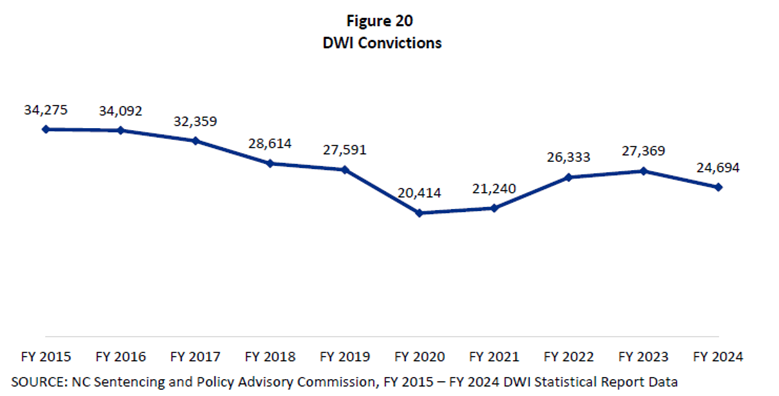
Scope. The report focused on offenses sentenced pursuant to G.S. 20-179. The offenses included in the report were impaired driving, impaired driving in a commercial vehicle, a second or subsequent conviction for operating a commercial vehicle after consuming alcohol, and a second or subsequent conviction for operating a school bus, school activity bus, child care vehicle, ambulance, other EMS vehicle, firefighting vehicle, or law enforcement vehicle after consuming alcohol. It included convictions from July 1, 2023 through June 30, 2024. Statewide, this amounts to 24,694 convictions.
The report did not include convictions of aiding and abetting DWI and habitual DWI. While sentencing for aiding and abetting DWI is governed by G.S. 20-179, it is always sentenced at a Level 5 (G.S. 20-179(f1)). Moreover, aiding and abetting DWI does not include impaired driving by the defendant as an element. Habitual DWI is not sentenced pursuant to G.S. 20-179. It is a class F felony and is sentenced pursuant to the Structured Sentencing Act. Because the report only includes data post-conviction, it does not include the conviction rate or other methods of disposition (such as magistrate findings of no probable cause, or dismissals by the prosecutor versus by the court).
Background. Briefly, there are 6 sentencing levels which may be imposed during DWI sentencing pursuant to G.S. 20-179. From most to least punitive, they are Levels A1, 1, 2, 3, 4, and 5. If the judge finds any “grossly aggravating factors” (as listed in G.S. 20-179(c)), they must sentence the defendant to Level A1, 1, or 2 based on the number and type of grossly aggravating factors found. If there are no grossly aggravating factors, the judge must sentence the defendant to a Level 3, 4, or 5 sentence based on the weight, presence, and/or absence of aggravating factors (G.S. 20-179(d)) and mitigating factors (G.S. 20-179(e)).
Highlights. The following are some of the notable highlights from the report. While this post focuses on the statewide highlights and trends, the report also includes comprehensive data by judicial district in Appendix C.
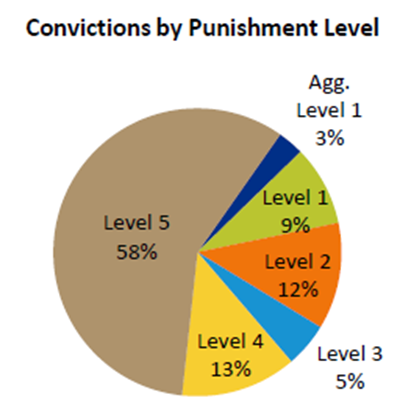
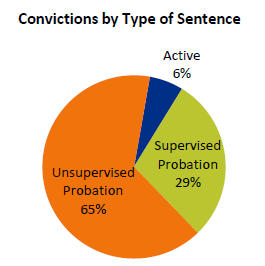
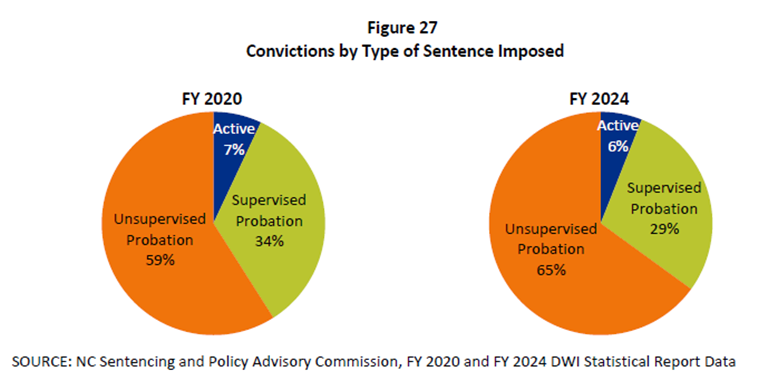
Nearly 60% of convictions in FY 2024 resulted in a Level 5 sentence. Further, 76% of convictions were Levels 3, 4, or 5. This means for just over three-quarters of all convictions, there were no grossly aggravating factors. Among all sentences imposed, 94% of defendants were placed on probation, the majority of which were placed on unsupervised probation. This is consistent with the level of sentences imposed without any grossly aggravating factors, and the proportion where the judge imposed a Level 5 sentence.
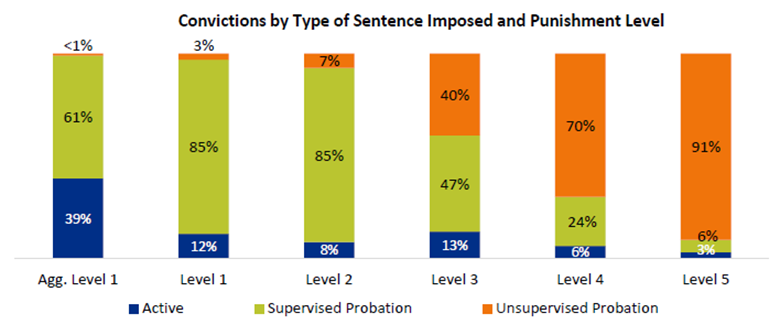
Within each sentence level, the distribution of active sentences, supervised probation, and unsupervised probation is shown below. Notably, there are significant decreases in the proportion of defendants placed on unsupervised probation as the sentences go from Level 5, to 4, to 3, and then 2, and increases in the proportion of defendants placed on supervised probation instead. The changes in active sentences are less drastic until Level A1, which has a 27% increase in active sentences over Level 1. Interestingly, a higher proportion of Level 3 sentences are active sentences than Level 2. This may be because Level 3 sentences are imposed when aggravating factors substantially outweigh any mitigating factors, and Level 2 sentences must be imposed when one grossly aggravating factor is present (except for the factor in G.S. 20-179(c)(4)), notwithstanding how much mitigation is present. If there are significant mitigating factors and there is one grossly aggravating factor, the sentence level remains a Level 2. As a result, the impact of this could be that more Level 2 sentences are adjusted to account for mitigation, whereas Level 3 sentences would more likely drop in sentencing level to 4 or 5.
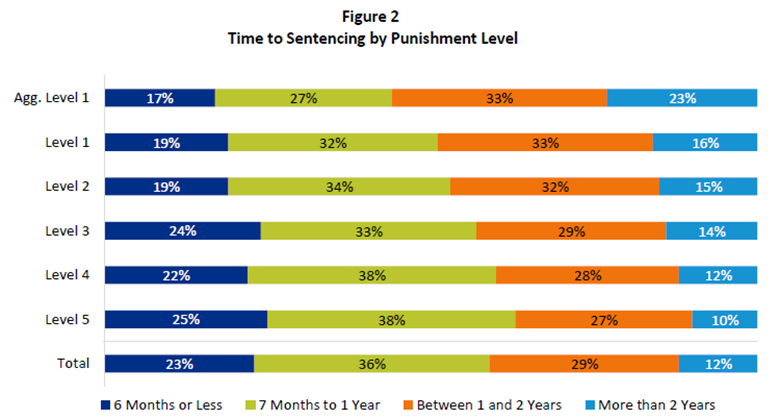
The time to sentencing among convictions included in the report also vary by sentencing level. On average, nearly 60% of cases took less than one year between the date of offense and sentencing, and about 40% took more than one year. However, for Level A1 sentences, this is almost the other way around, with close to 60% taking more than one year, and almost 25% taking more than two years to reach sentencing. Level A1 sentences must be imposed when there are three or more grossly aggravating factors, the judge does not have discretion to impose a different level. In these cases, a judge may impose an active sentence of up to three years, and if the judge does suspend the sentence, they must impose a split sentence of at least 120 days. One reason they take the longest time to sentencing may be in order for the defendant to participate in as much mitigation as possible, including obtaining a substance abuse assessment and complying with the recommendations, or spending time at an inpatient treatment facility. While these factors would not permit a judge to depart from imposing a Level A1 sentence, they may be the difference between an active sentence and a suspended sentence.
Trends. The past few years have included the COVID pandemic, recovery from the COVID pandemic, and the transition to an electronics courts system, Enterprise Justice. The following are some trends to give this year’s report more context.
For the last near-decade, the total number of DWI convictions has been trending downwards. There is a significant drop in FY 2020 and FY 2021, with numbers rising again in FY 2022 and FY 2023. This likely reflects the reduction in court operations during the COVID pandemic, and the subsequent increase would include convictions from FY 2022 and FY 2023 plus the backlog from the two years prior. FY 2024 reflected the first subsequent decrease, nearly 3000 convictions below that of FY 2019, the last year to not be affected by the pandemic. The overall decrease is even more notable when considered in light of the fact that North Carolina’s total population increased by roughly 1.1 million people during the last decade, according to the North Carolina Office of State Budget and Management.
Compared to FY 2020, the number of sentences that included any grossly aggravating factors decreased by 3%. Statewide, that amounted to over 740 convictions. While the percentage of Level A1 sentences remained the same, there was a decrease in the amount of Level 1, 2, and 3 sentences, and an increase in the number of Level 4 and 5 sentences. This reflects both that fewer grossly aggravating factors are being found during sentencing, and that sentencing levels are trending downwards towards Level 4 and 5 sentences.
While sentencing levels are trending towards the lower levels, the time to sentencing appears to be increasing. In FY 2020, 65% of convictions came within 1 year, while in FY 2024, that dropped to 59%. In addition, there was a 4% increase in convictions that came more than 2 years after the date of offense, which amounts to just under 1,000 cases. Considering the delays created by the COVID pandemic during the latter part of FY 2020, and the subsequent transition to Enterprise Justice, it will be interesting to see if the time to sentencing will decrease going forward.
The increase in time to sentencing is also slightly at odds with the trend in methods of disposition. From FY 2020 to FY 2024, the percentage of convictions following a guilty plea increased from 87% to 92%, with the remainder of convictions following a bench trial (8%) or jury trial (<1%).
Finally, there appears to be a shift in the type of probation imposed. While the divide between probationary sentences and active sentences remained nearly the same between FY 2020 and FY 2024, there was a near 6% increase in the imposition of unsupervised probation versus supervised probation. This is consistent with the trend in sentencing levels moving towards more Level 4 and 5 sentences, and fewer Level A1, 1, 2, and 3 sentences.
Looking forward. Based on these trends and statewide efforts to combat impaired driving, there is strong evidence that the total number of DWI convictions will continue to decrease, and that the sentences imposed will include fewer grossly aggravating factors and more unsupervised probation. As districts spend more time with the still-new implementation of Enterprise Justice, it will also be interesting to keep an eye on time to sentencing and see how those trends develop.
As always, feel free to reach out to me with any questions or comments. I can be reached at elrahal@sog.unc.edu.